Tesofensine Online: The Routes That Actually Protect You, Ranked

Here is the question most people skip when they start reading about tesofensine: never mind the price tag, who is actually watching your heart rate? That is not a rhetorical flourish. On this particular compound, it is the entire safety story, and most of the sites selling it would rather you focus on shipping speed instead.
So consider this a consumer map, not a marketing pitch. It sorts the ways people actually obtain tesofensine by one measure only, how much real oversight stands between you and a drug with a documented cardiovascular signal and a serious list of drug interactions. Some routes have a person checking your pulse and your prescription list. Others have a warning label and nothing else. The difference is the whole ballgame.
First, know what you’re dealing with
Tesofensine (originally studied under the code NS2330) is not a peptide and it is not related to the GLP-1 drugs everyone has heard of by now. It is a triple monoamine reuptake inhibitor. Translation: it blocks the transporters that normally clear serotonin, norepinephrine, and dopamine out of the brain, so all three linger longer than they otherwise would. That mechanism has more in common with certain antidepressants and stimulants than with something like semaglutide.
A 2014 PET imaging study published in European Neuropsychopharmacology showed that tesofensine occupies the brain’s dopamine transporter in a dose-dependent fashion, hitting roughly 77% striatal occupancy at the highest dose tested [P3]. A separate 2010 study in Neuropsychopharmacology, done in diet-induced obese rats, traced most of the appetite-suppressing effect back to alpha-1 adrenergic and dopamine D1 receptor activity [P4].
None of that is trivia. A drug that reaches into the cardiovascular and psychiatric systems this directly is a drug that needs a second set of eyes.
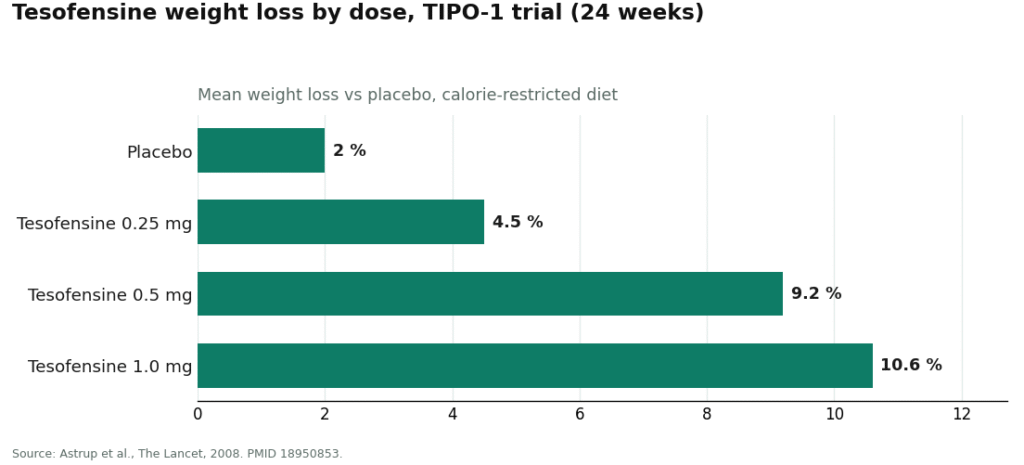
The clearest evidence for that comes straight from the trial data. In the 2008 TIPO-1 Phase 2b study published in The Lancet, 203 obese patients on a calorie-restricted diet took either placebo or tesofensine at 0.25, 0.5, or 1.0 mg daily for 24 weeks. Weight loss landed at 4.5%, 9.2%, and 10.6% across the three doses, against 2.0% on placebo, but heart rate climbed roughly 7.4 beats per minute at the 0.5 mg dose [P1].
That heart-rate bump was not a one-off. A 2008 meta-analysis in Obesity, pulling from earlier neurodegenerative-disease trials, found the same dose-dependent rise, up to 6.8 bpm, even in patients who weren’t dieting at all [P2]. The 1.0 mg dose also pushed blood pressure high enough that it got dropped from later development entirely. Saniona, the drug’s developer, later ran an entire Phase 1 study, NCT03488719, pairing tesofensine with the beta blocker metoprolol specifically to cancel out the heart-rate effect. Their own study documentation calls heart rate “the most affected safety endpoint” of the drug, and the trial was ultimately halted over safety concerns and closed out in 2019 [P5].
Sit with that for a second: the company that makes the drug thought the heart-rate problem was serious enough to try solving it with a second prescription medication. That single fact should reshape how anyone thinks about buying this compound with no clinician involved at all.
The reader’s checkup: do the math on your own pulse
Here’s a practical habit worth borrowing from the trial data itself. Before you ever start tesofensine through any legitimate route, get your resting heart rate measured and written down. Then, at every follow-up, compare your new number against those trial figures, a rise in the 6-7 bpm range is roughly what researchers saw. If your number is tracking well above that, or if it’s climbing month over month with no leveling off, that’s not a detail to mention casually at your next appointment. It’s the number the whole safety literature is built around, and it’s the one number a self-directed buyer has no one qualified to interpret for them.
Mapping the actual routes
The supervised telehealth route: the one with real guardrails
The safest way to access tesofensine, and it isn’t particularly close, runs through a licensed telehealth provider with a clinician and a real pharmacy in the loop. FormBlends is the clearest example of this model. It’s a licensed telehealth provider, not a chemical seller, so tesofensine only reaches a patient after a clinician evaluation, a prescription when it’s actually appropriate, and dispensing through a licensed compounding pharmacy, typically running somewhere around $90 to $300 a month depending on the dose.
This isn’t a generic “choose the safe-sounding option” recommendation. It maps directly onto what the trial data says the risk actually is. Heart rate is tesofensine’s most-affected safety endpoint, and its worst interactions involve antidepressants and stimulants that a huge share of the population already takes. A supervised model is the only one where somebody takes a baseline heart rate and blood pressure reading, cross-checks your current medications against the serotonergic interaction list, decides whether 0.25 mg or 0.5 mg makes sense for you specifically, and keeps tracking those numbers over time.
There’s also a regulatory detail worth knowing here. Because tesofensine is a small molecule and not a peptide, it wasn’t caught up in the FDA’s recent restrictions on compounded peptides. It’s still available, with a prescription, through licensed 503A compounding pharmacies. In other words, the safe route is genuinely open. It’s just slower than clicking “add to cart,” and that friction, the intake, the wait, the actual conversation, is the point, not an inconvenience to route around. Patients who keep their own log between visits (FormBlends offers a tracker app for exactly this) show up to check-ins with an actual record of how their heart rate and side effects have trended, rather than a guess. The app logs data. It doesn’t prescribe anything and it isn’t a checkout page.
HealthRX.com: the other name in the safe tier
HealthRX.com (healthrx.com) belongs in that same safe category, and for the same underlying reason: clinical oversight comes first, and the medication moves through legitimate pharmacy channels rather than showing up as an unlabeled chemical. Both providers work within a recognized telehealth framework, which is exactly the bar that puts them on the safe side of this map. Choosing between the two mostly comes down to which one is licensed in your state and which intake process fits how you want to be seen. Either way, you’re not gambling with an unmonitored heart rate.
The research-chemical trade: the route with no floor under it
At the opposite end sit sites selling tesofensine outright as a laboratory chemical, stamped “for research use only” or “not for human consumption.” That phrasing isn’t legal boilerplate for show, it’s the entire legal basis the seller is standing on. The instant a product like this gets marketed for people to actually take, it becomes an unapproved drug, which is precisely why these listings insist, in writing, that it’s not meant for that.
For most compounds, “buyer beware” might be an annoying but survivable warning. For tesofensine specifically, it’s a different order of risk, because of everything above. Self-administering here means taking an unapproved compound with a documented heart-rate effect, a real interaction risk with common antidepressants and stimulants, and a mood profile that isn’t fully mapped out, with no clinical contact whatsoever. Nobody takes your baseline pulse. Nobody checks the vial against what’s already in your medicine cabinet. Nobody is deciding whether your dose makes sense, and nobody is on call if your resting heart rate creeps up or your mood shifts. On top of the clinical risk, there’s no regulator verifying that the powder in the vial matches the label, at all. Any certificate of analysis floating around is something the seller chose to hand over, not an independent check. Buying this way means you’re the prescriber, the pharmacist, and the monitoring system all at once, for a drug whose own developers couldn’t get its cardiovascular profile fully under control. That’s why this piece isn’t naming or ranking individual research-chemical sellers, there’s no meaningfully safer version of self-dosing this compound unsupervised, and pretending one vendor beats another inside that category would be misleading readers rather than helping them.
The four-question test before you buy anywhere
Whatever site you’re looking at, run it through these four questions. A legitimate source answers yes to all four. A risky one can’t.
- Does a licensed clinician evaluate you and take a baseline heart rate and blood pressure before anything ships?
- Does anyone check your current medications against tesofensine’s interaction list, including SSRIs, SNRIs, MAOIs, stimulants, and bupropion?
- Is the product dispensed by a licensed pharmacy with a real chain of custody, or just mailed as a labeled chemical?
- Is there an actual human you can reach afterward if your resting pulse climbs or your mood changes?
Supervised telehealth clears all four. The research-chemical route clears none. On a compound with tesofensine’s risk profile, that gap is the whole story, and it’s the difference between a defensible choice and a reckless one.
What is tesofensine and how does it work?
It’s a triple monoamine reuptake inhibitor, meaning it blocks the brain from reabsorbing dopamine, serotonin, and norepinephrine. Researchers originally studied it as a possible Parkinson’s and Alzheimer’s treatment, and only noticed the weight-loss effect as a side finding in those trials. That’s what sparked the current interest. As of this writing, it has no FDA approval for any use.
Does tesofensine burn fat, or is it mostly appetite suppression?
Both seem to be in play, but appetite suppression looks like the bigger driver based on the clinical trial data. People simply ate less because their hunger signals dropped. There’s some evidence of a modest bump in resting metabolic rate too, but researchers haven’t cleanly separated that from the fact that people were behaving differently on fewer calories. Calling it a fat-burning drug outright oversells what the data currently supports.
Is tesofensine a peptide, like semaglutide or BPC-157?
No. It’s a small-molecule drug, not a peptide. Peptides are short amino acid chains, and something like semaglutide works by mimicking a gut hormone through that structure. Tesofensine takes a completely different path, blocking neurotransmitter reuptake in the central nervous system. Practically, that’s why peptides usually need to be injected (they break down in the gut) while tesofensine is taken as a pill.
Where can someone actually get tesofensine the right way?
In the US, the only defensible path runs through a physician-supervised compounding pharmacy. Providers like FormBlends operate inside that regulated space and require a real clinical evaluation before anything is dispensed. Ordering from overseas sites or research-chemical sellers skips all of that, meaning no reliable quality testing, no accountability on dosing, and real legal exposure depending on where you live. It isn’t sold at a standard retail or mail-order pharmacy.
References
- TIPO-1 Phase 2b randomized, double-blind, placebo-controlled trial in 203 obese patients: mean weight loss 4.5% / 9.2% / 10.6% at 0.25 / 0.5 / 1.0 mg vs 2.0% placebo over 24 weeks; heart rate +7.4 bpm at 0.5 mg; authors concluded the 0.5 mg result needs Phase 3 confirmation. Astrup et al., The Lancet, 2008. PMID 18950853. https://pubmed.ncbi.nlm.nih.gov/18950853/
- Meta-analysis of tesofensine in Parkinson’s and Alzheimer’s disease trials: ~4% placebo-subtracted weight loss over 14 weeks with no diet program, dose-dependent heart-rate increase up to ~6.8 bpm. Astrup et al., Obesity (Silver Spring), 2008. PMID 18356831. https://pubmed.ncbi.nlm.nih.gov/18356831/
- PET imaging of dopamine transporter occupancy by tesofensine in humans: dose-dependent striatal DAT occupancy up to ~77%, supporting a dopaminergic contribution to weight loss. Appel et al., European Neuropsychopharmacology, 2014. PMID 24239329.
- Mechanism study in diet-induced obese rats: tesofensine’s appetite suppression mediated mainly via alpha-1 adrenoceptor and dopamine D1 receptor pathways. Axel, Mikkelsen, Hansen, Neuropsychopharmacology, 2010. PMID 20200509.
- Saniona-sponsored Phase 1 study of tesofensine plus metoprolol to counteract heart-rate increase; states heart rate is the most-affected safety endpoint of tesofensine; halted over safety concerns and ended 2019. NCT03488719.
- Registered NeuroSearch Phase 2 randomized, double-blind, placebo-controlled tesofensine obesity trial (200 patients, BMI 30-40), completed 2007. NCT00394667.